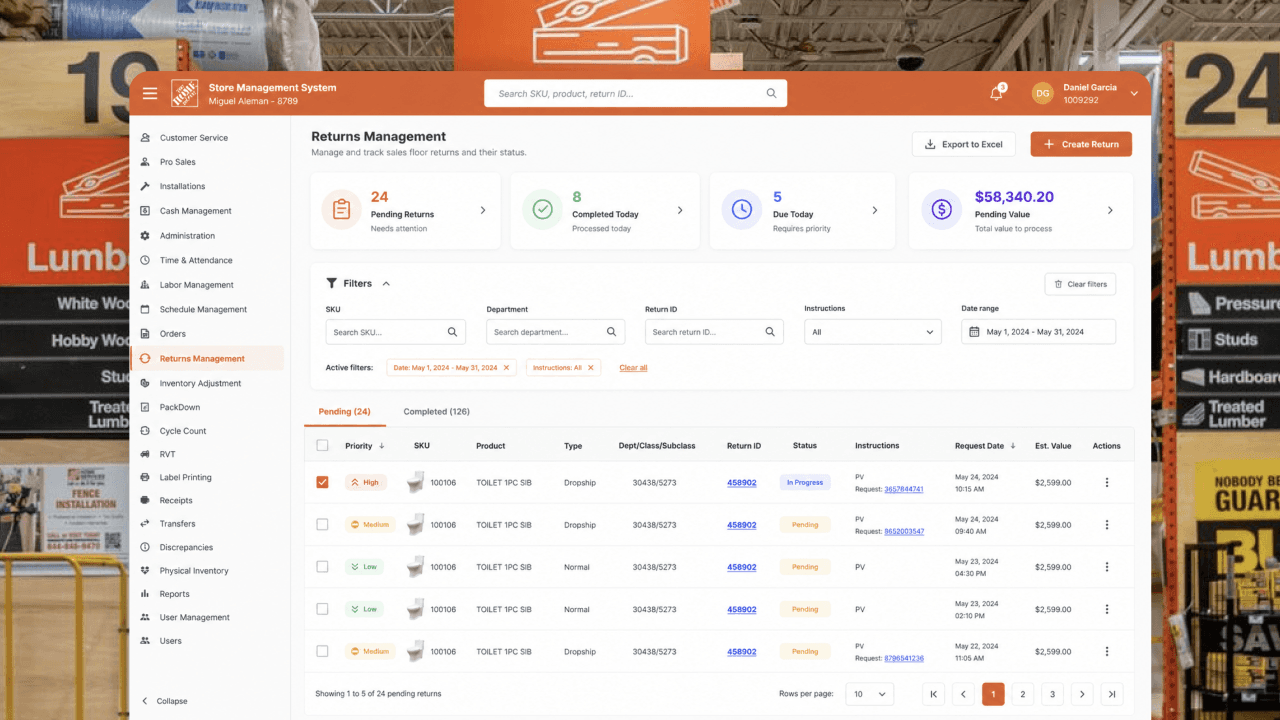
A mockup of a mobile for job gate home screen

Product Designer

Product Designer

Figma / Figjam / Jira / Teams / Maze / Hotjar / Confluence/

Figma / Figjam / Jira / Teams / Maze / Hotjar / Confluence/

Figma / Figjam / Jira / Teams / Maze / Hotjar / Confluence/

PM / Devs / Stakeholders

PD, PO, Devs, Stakeholders,

Figma / Figjam / Jira / Teams / Maze / Hotjar / Confluence/

Figma / Figjam / Jira / Teams / Maze / Hotjar / Confluence/

PM / Devs / Stakeholders

PD, PO, Devs, Stakeholders,

Home Depot

Reducing operational friction across one of North America's largest retail supply chains

THE PROBLEM

Store associates understood their jobs.

The systems made those jobs harder than they needed to be.

The Home Depot operates one of the largest retail supply chains in North America.

Every day, store associates receive shipments, count inventory, update stock levels, and ensure products remain available for customers.

These activities happen continuously, often while employees are assisting customers, moving throughout the store, and responding to operational demands.

The challenge was reducing the effort required to perform routine operational tasks accurately and efficiently.

As operational complexity increased, small inefficiencies multiplied across thousands of stores and millions of inventory transactions.

Manual counting created avoidable errors

Manual counting created avoidable errors

Inventory discrepancies frequently originated during material counting and data entry workflows.

Every additional interaction increased the likelihood of mistakes.

Inventory discrepancies frequently originated during material counting and data entry workflows.

Every additional interaction increased the likelihood of mistakes.

Inventory discrepancies frequently originated during material counting and data entry workflows.

Every additional interaction increased the likelihood of mistakes.

Shipment visibility was fragmented

Shipment visibility was fragmented

Critical shipment information existed across multiple systems, forcing employees to switch contexts to complete operational tasks.

Critical shipment information existed across multiple systems, forcing employees to switch contexts to complete operational tasks.

Critical shipment information existed across multiple systems, forcing employees to switch contexts to complete operational tasks.

Operational tasks happened under constant interruption

Operational tasks happened under constant interruption

Associates rarely completed workflows in controlled environments.

Tasks were frequently interrupted by customer interactions and competing priorities.

Associates rarely completed workflows in controlled environments.

Tasks were frequently interrupted by customer interactions and competing priorities.

Associates rarely completed workflows in controlled environments.

Tasks were frequently interrupted by customer interactions and competing priorities.

"Store associates don't need more tools. They need fewer steps."

"Store associates don't need more tools. They need fewer steps."

Research Insight

Research Insight

A screenshot of job gate home, job details, and filters screens

We weren't redesigning inventory management.

We were redesigning operational efficiency.

DISCOVERY

DISCOVERY

The initial assumption was that inventory inaccuracies originated from counting problems.

Research revealed a broader issue.

Employees generally understood their responsibilities and operational procedures. It was effort.

Many workflows required unnecessary actions, repeated decisions, and context switching across systems.

This shifted the project away from feature development and toward friction reduction.

The goal became helping associates complete operational tasks faster, with less effort, and greater confidence.

The initial assumption was that inventory inaccuracies originated from counting problems.

Research revealed a broader issue.

Employees generally understood their responsibilities and operational procedures. It was effort.

Many workflows required unnecessary actions, repeated decisions, and context switching across systems.

This shifted the project away from feature development and toward friction reduction.

The goal became helping associates complete operational tasks faster, with less effort, and greater confidence.

The initial assumption was that inventory inaccuracies originated from counting problems.

Research revealed a broader issue.

Employees generally understood their responsibilities and operational procedures. It was effort.

Many workflows required unnecessary actions, repeated decisions, and context switching across systems.

This shifted the project away from feature development and toward friction reduction.

The goal became helping associates complete operational tasks faster, with less effort, and greater confidence.

Shipment arrival processes

Material counting workflows

Operational interruptions

Inventory update behaviors

the foundation for prioritizing workflow simplification.

The map revealed that most friction occurred during repetitive operational actions rather than complex decision-making.

The map revealed that most friction occurred during repetitive operational actions rather than complex decision-making.

TARGET USERS
Sarah
Store Associate

Store Associate

Needs fast workflows that support inventory and shipment tasks without disrupting customer interactions

Needs fast workflows that support inventory and shipment tasks without disrupting customer interactions

A screenshot of job gate home, job details, and filters screens
Michael

Operations Supervisor

→ How might we improve visibility across shipment workflows?

Needs accurate inventory data and visibility into store operations.

→ How might we support employees working in fast-paced environments?

A screenshot of job gate home, job details, and filters screens
Persona #3

Regional Operations Teams

→ How might we improve visibility across shipment workflows?

Needs accurate inventory data and visibility into store operations.

→ How might we support employees working in fast-paced environments?

A screenshot of job gate home, job details, and filters screens

01 Design Decision

Helps small business owners manage inventory and place recurring orders

Connects with thousands of retailers across Mexico, supporting the daily operations of convenience stores, corner shops, and local businesses.

how might we...

→ How might we reduce errors during inventory counting?

→ How might we improve visibility across shipment workflows?

→ How might we support employees working in fast-paced environments?

→ How might we support employees working in fast-paced environments?

01

Material Counting

Research showed that counting interactions generated a significant portion of inventory inaccuracies. We redesigned counting experiences to reduce the number of actions required to complete updates.

Tradeoff

Reduced operational effort while improving confidence during inventory updates.

02
Critical Information

Shipment status, inventory updates, and operational information were often hidden behind multiple navigation layers. We prioritized immediate access to the most important information

Tradeoff

Less frequently used functionality became secondary within the experience.

03

Real-Time Inventory Updates

Operational delays frequently occurred between physical actions and system updates.

We redesigned workflows to synchronize inventory updates more directly with store activities.

Tradeoff

Improved inventory accuracy and operational awareness.

A screenshot of job gate filters popup
DEFINE

Helps small business owners manage inventory and place recurring orders

Connects with thousands of retailers across Mexico, supporting the daily operations of convenience stores, corner shops, and local businesses.

store owners value speed, simplicity, and reliability.

Store owners value speed, simplicity, and reliability.

the experience should be optimized for reordering, not browsing

store owners value speed, simplicity, and reliability.

150+

Many place orders multiple times per week to restock their stores.

6

Order products regularly to maintain inventory and serve customers

18

Content

150+
150+
150+
150+

Many place orders multiple times per week to restock their stores.

store owners value speed, simplicity, and reliability.

Small corner stores

1 to 3 employees. Low digital maturity

Reorder, don't stop

4 to 10 employees. Use digital tools ocasionally

Distributors & Wholesalers

High order volume. More complex operations

Distributors & Wholesalers

High order volume. More complex operations

Distributors & Wholesalers

High order volume. More complex operations

A screenshot of job gate filters popup

Content

Content

store owners value speed, simplicity, and reliability.

Step-by-step flows that teach and guide users without overhelming them.

Learning moments embedded naturally within the user journey.

Recomendations based on user interests, goals and behavior.

Visual and simple explanations of perfomance risk.

Define

Helps small business owners manage inventory and place recurring orders

Connects with thousands of retailers across Mexico, supporting the daily operations of convenience stores, corner shops, and local businesses.

Store owners value speed, simplicity, and reliability.

Small corner stores

1 to 3 employees. Low digital maturity

Reorder, don't stop

4 to 10 employees. Use digital tools ocasionally

Distributors & Wholesalers

High order volume. More complex operations

Distributors & Wholesalers

High order volume. More complex operations

FINAL EXPERIENCE

Small corner stores

1 to 3 employees. Low digital maturity

Small corner stores

1 to 3 employees. Low digital maturity

Small corner stores

1 to 3 employees. Low digital maturity

Small corner stores

1 to 3 employees. Low digital maturity

Define

Helps small business owners manage inventory and place recurring orders

Connects with thousands of retailers across Mexico, supporting the daily operations of convenience stores, corner shops, and local businesses.

1 to 3 employees. Low digital maturity

4 to 10 employees. Use digital tools ocasionally

High order volume. More complex operations

FINAL EXPERIENCE

FINAL EXPERIENCE

FINAL EXPERIENCE

1 to 3 employees. Low digital maturity

4 to 10 employees. Use digital tools ocasionally

High order volume. More complex operations

High order volume. More complex operations

FINAL EXPERIENCE

1 to 3 employees. Low digital maturity

4 to 10 employees. Use digital tools ocasionally

High order volume. More complex operations

High order volume. More complex operations

FINAL EXPERIENCE

FINAL EXPERIENCE

FINAL EXPERIENCE

1 to 3 employees. Low digital maturity

1 to 3 employees. Low digital maturity

4 to 10 employees. Use digital tools ocasionally

1 to 3 employees. Low digital maturity

High order volume. More complex operations

1 to 3 employees. Low digital maturity

High order volume. More complex operations

1 to 3 employees. Low digital maturity

1 to 3 employees. Low digital maturity

4 to 10 employees. Use digital tools ocasionally

Distributors & Wholesalers

High order volume. More complex operations