A mockup of a mobile for job gate home screen

Role

Product Designer

Figma / Figjam / Jira / Teams / Maze / Hotjar / Confluence/

Figma / Figjam / Jira / Teams / Maze / Hotjar / Confluence/

Figma / Figjam / Jira / Teams / Maze / Hotjar / Confluence/

PM / Devs / Stakeholders

PD, PO, Devs, Stakeholders,

Figma / Figjam / Jira / Teams / Maze / Hotjar / Confluence/

Figma / Figjam / Jira / Teams / Maze / Hotjar / Confluence/

PM / Devs / Stakeholders

PD, PO, Devs, Stakeholders,

Coca Cola

Redesigning inventory replenishment for thousands of small business owners across Latin America

THE PROBLEM

The platform was designed for shopping.

Users were trying to restock a business.

Coca-Cola's ordering platform supports thousands of convenience stores, small retailers, and neighborhood businesses across Latin America.

Over time, the experience evolved like a traditional ecommerce platform.

The assumption was simple:

  • Users open the app to discover products and build orders.

  • Research revealed the opposite.

  • Most store owners already knew exactly what they needed before opening the platform.

  • The product optimized for exploration.

  • Users optimized for efficiency.

Same order every week

Same order every week

Store owners frequently purchased the same products in similar quantities.

Despite this, they were forced to recreate orders from scratch every time.

Store owners frequently purchased the same products in similar quantities.

Despite this, they were forced to recreate orders from scratch every time.

Store owners frequently purchased the same products in similar quantities.

Despite this, they were forced to recreate orders from scratch every time.

Created unnecessary work

Created unnecessary work

Browsing categories, navigating catalogs, and searching for products added effort without adding value.

Users had already made the purchasing decision.

Browsing categories, navigating catalogs, and searching for products added effort without adding value.

Users had already made the purchasing decision.

Browsing categories, navigating catalogs, and searching for products added effort without adding value.

Users had already made the purchasing decision.

Platform ignored operational reality

Platform ignored operational reality

Store owners manage inventory, suppliers, customers, and cash flow simultaneously.

Ordering inventory is not shopping. It is an operational task.

Store owners manage inventory, suppliers, customers, and cash flow simultaneously.

Ordering inventory is not shopping. It is an operational task.

Store owners manage inventory, suppliers, customers, and cash flow simultaneously.

Ordering inventory is not shopping. It is an operational task.

"I already know what I need. I just need to order it again."

"I already know what I need. I just need to order it again."

Store Owner Interview

Store Owner Interview

A screenshot of job gate home, job details, and filters screens

We weren't redesigning ecommerce.

We were redesigning replenishment.

DISCOVERY

The turning point came when we stopped analyzing the platform as a shopping experience and started analyzing it as an operational tool.

Research showed that most users weren't browsing.

They were replenishing inventory.

The distinction changed everything.

Rather than focusing on helping users choose products, the experience needed to help them repeat purchasing behaviors they had already established.

This shifted the project from product discovery to operational efficiency.

The turning point came when we stopped analyzing the platform as a shopping experience and started analyzing it as an operational tool.

Research showed that most users weren't browsing.

They were replenishing inventory.

The distinction changed everything.

Rather than focusing on helping users choose products, the experience needed to help them repeat purchasing behaviors they had already established.

This shifted the project from product discovery to operational efficiency.

The turning point came when we stopped analyzing the platform as a shopping experience and started analyzing it as an operational tool.

Research showed that most users weren't browsing.

They were replenishing inventory.

The distinction changed everything.

Rather than focusing on helping users choose products, the experience needed to help them repeat purchasing behaviors they had already established.

This shifted the project from product discovery to operational efficiency.

Ordering frequency

Product repetition patterns

Navigation paths

Ordering bottlenecks

This became the foundation for prioritizing quick-order experiences.

The artifact revealed that the majority of friction occurred before users reached the products they intended to purchase.

The artifact revealed that the majority of friction occurred before users reached the products they intended to purchase.

TARGET USERS
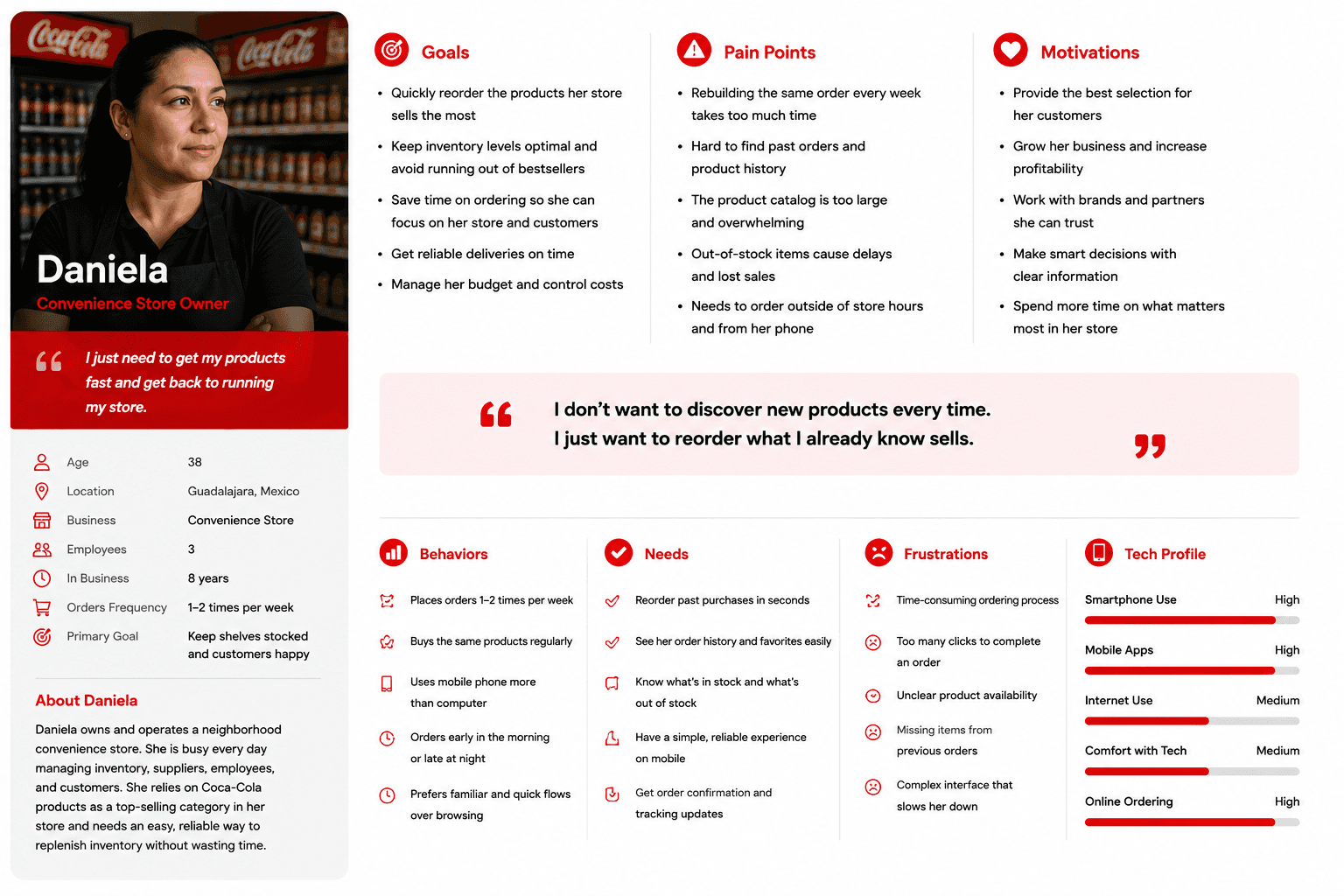
Daniela
Convenience Store Owner

Convenience Store Owner

Needs to replenish inventory quickly without navigating large catalogs

Needs to replenish inventory quickly without navigating large catalogs

A screenshot of job gate home, job details, and filters screens
José

Small Retail Operator

→ How might we align the digital experience with real-world inventory management?

Small Retail Operator

→ How might we reduce effort during recurring purchases?

A screenshot of job gate home, job details, and filters screens
Persona #3

Regional Sales Teams

→ How might we align the digital experience with real-world inventory management?

Small Retail Operator

→ How might we reduce effort during recurring purchases?

A screenshot of job gate home, job details, and filters screens

01 Design Decision

Helps small business owners manage inventory and place recurring orders

Connects with thousands of retailers across Mexico, supporting the daily operations of convenience stores, corner shops, and local businesses.

How might we...

→ How might we help store owners replenish inventory without rebuilding orders manually?

→ How might we align the digital experience with real-world inventory management?

→ How might we reduce navigation friction across large product catalogs?

→ How might we reduce effort during recurring purchases?

01

Design Around Reordering

Research showed users repeatedly purchased similar products. Rather than prioritizing catalog exploration, the experience prioritized previous purchasing behavior. Users could begin with products they had already purchased instead of starting from the catalog

Tradeoff

This reduced visibility of the broader product assortment. However, research showed speed was significantly more valuable than discovery for core users.

02 Design decision
Introduce Quick Order Experiences

The existing workflow required users to manually rebuild inventory purchases. We introduced quick-order functionality that leveraged purchase history and previous behavior.

Tradeoff

Additional complexity within order management systems.

The efficiency gains outweighed the implementation cost

03

Reorganize Categories

The original structure reflected internal product organization.

We redesigned categories to resemble how store owners think about inventory inside physical stores.

Tradeoff

Improved product discoverability within established purchasing patterns.

A screenshot of job gate filters popup
DEFINE

Helps small business owners manage inventory and place recurring orders

Connects with thousands of retailers across Mexico, supporting the daily operations of convenience stores, corner shops, and local businesses.

store owners value speed, simplicity, and reliability.

Store owners value speed, simplicity, and reliability.

the experience should be optimized for reordering, not browsing

store owners value speed, simplicity, and reliability.

150+

Many place orders multiple times per week to restock their stores.

6

Order products regularly to maintain inventory and serve customers

18

Content

150+
150+
150+
150+

Many place orders multiple times per week to restock their stores.

store owners value speed, simplicity, and reliability.

Small corner stores

1 to 3 employees. Low digital maturity

Reorder, don't stop

4 to 10 employees. Use digital tools ocasionally

Distributors & Wholesalers

High order volume. More complex operations

Distributors & Wholesalers

High order volume. More complex operations

Distributors & Wholesalers

High order volume. More complex operations

A screenshot of job gate filters popup

Content

Content

store owners value speed, simplicity, and reliability.

Step-by-step flows that teach and guide users without overhelming them.

Learning moments embedded naturally within the user journey.

Recomendations based on user interests, goals and behavior.

Visual and simple explanations of perfomance risk.

Define

Helps small business owners manage inventory and place recurring orders

Connects with thousands of retailers across Mexico, supporting the daily operations of convenience stores, corner shops, and local businesses.

Store owners value speed, simplicity, and reliability.

Small corner stores

1 to 3 employees. Low digital maturity

Reorder, don't stop

4 to 10 employees. Use digital tools ocasionally

Distributors & Wholesalers

High order volume. More complex operations

Distributors & Wholesalers

High order volume. More complex operations

FINAL EXPERIENCE

Small corner stores

1 to 3 employees. Low digital maturity

Small corner stores

1 to 3 employees. Low digital maturity

Small corner stores

1 to 3 employees. Low digital maturity

Small corner stores

1 to 3 employees. Low digital maturity

Define

Helps small business owners manage inventory and place recurring orders

Connects with thousands of retailers across Mexico, supporting the daily operations of convenience stores, corner shops, and local businesses.

1 to 3 employees. Low digital maturity

4 to 10 employees. Use digital tools ocasionally

High order volume. More complex operations

FINAL EXPERIENCE

FINAL EXPERIENCE

FINAL EXPERIENCE

1 to 3 employees. Low digital maturity

4 to 10 employees. Use digital tools ocasionally

High order volume. More complex operations

High order volume. More complex operations

FINAL EXPERIENCE

1 to 3 employees. Low digital maturity

4 to 10 employees. Use digital tools ocasionally

High order volume. More complex operations

High order volume. More complex operations

FINAL EXPERIENCE

FINAL EXPERIENCE

FINAL EXPERIENCE

1 to 3 employees. Low digital maturity

1 to 3 employees. Low digital maturity

4 to 10 employees. Use digital tools ocasionally

1 to 3 employees. Low digital maturity

High order volume. More complex operations

1 to 3 employees. Low digital maturity

High order volume. More complex operations

1 to 3 employees. Low digital maturity

1 to 3 employees. Low digital maturity

4 to 10 employees. Use digital tools ocasionally

Distributors & Wholesalers

High order volume. More complex operations